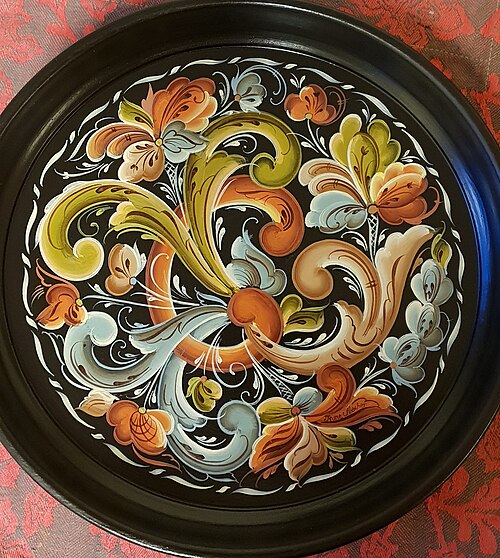
Rosemaling
Rosemaling—meaning “rose painting”—is a traditional form of decorative painting that originated in Norway in the 1700s. Early rosemalers drew inspiration from continental European art, but over time developed distinct regional styles that became uniquely Norwegian.
Most rosemalers were itinerant artisans who traveled from farm to farm, decorating interiors and furniture for landowners. As the practice spread, different regions developed recognizable styles—so distinct that the origin of a piece could often be identified at a glance. While floral designs were most common, some artists also painted figures, landscapes, biblical scenes, and animals. Movement between regions led to occasional blending of styles.
Like many Norwegian folk traditions, rosemaling was brought to North America by immigrants in the mid-1800s. However, as furniture styles and home décor trends evolved, the art form declined and was nearly lost. It experienced a revival in the 1950s, led by Norwegian-American communities seeking to reconnect with their cultural heritage. Today, rosemaling is once again a vibrant and valued expression of Norwegian identity.
When instructors are available, Solglyt workshops are offered. Details are shared through meetings, newsletters, and email updates.